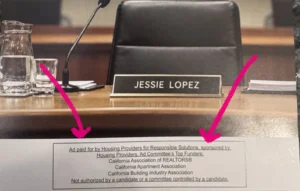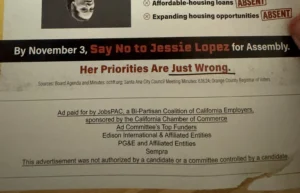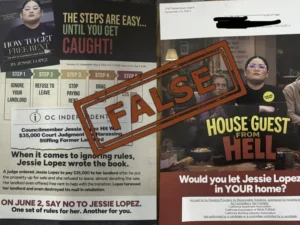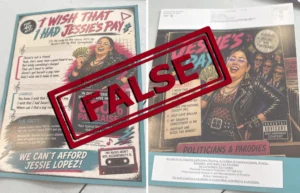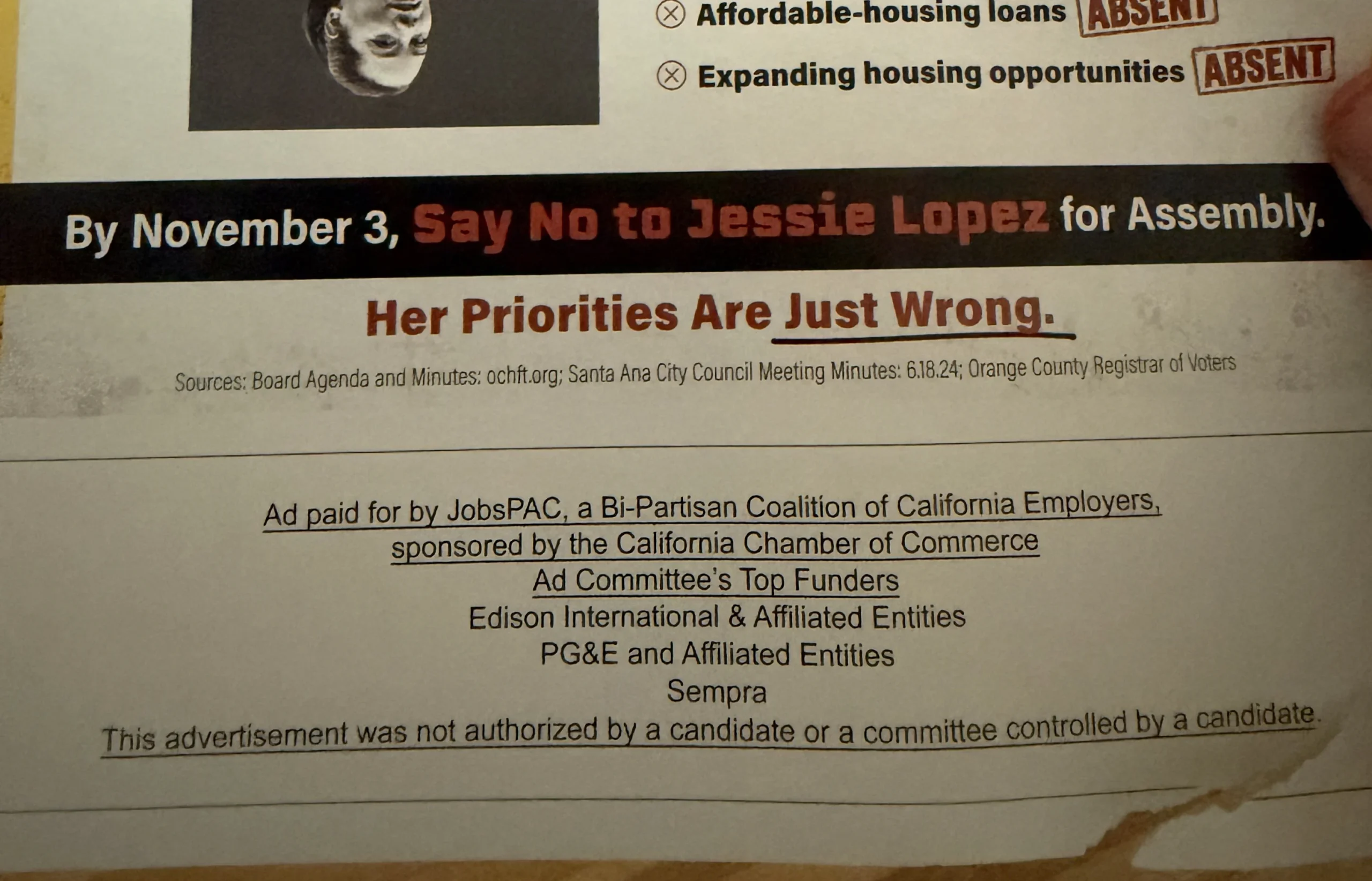
If you’ve received a political mailer attacking Jessie Lopez for State Assembly, you may have noticed something interesting in the fine print: some of the money behind these campaigns comes from major energy companies like Edison, Sempra, and PG&E.
Why would energy companies care about a State Assembly race?
Because the California Legislature makes decisions that directly affect the energy industry.
Assemblymembers vote on legislation involving electricity rates, utility regulation, wildfire prevention and liability, clean energy, infrastructure, environmental protections, and the rules governing California’s energy market. Those decisions can have significant financial consequences for large utilities and energy companies.
That gives these companies a reason to invest in candidates and political committees whose priorities are more closely aligned with their interests.
And the money doesn’t always flow directly to a candidate. California campaign finance law allows companies to contribute to political committees, which can then make independent expenditures supporting or opposing candidates. The California Secretary of State defines an independent expenditure as spending that advocates for or against a clearly identified candidate without coordination with that candidate’s campaign.
In AD-68, that distinction matters. Current FPPC records show that JobsPAC, a business-oriented political committee, has received significant funding from Edison International, Sempra, and PG&E-affiliated entities, and JobsPAC is among the committees supporting David Penaloza.
This is part of a much larger pattern of outside spending in the race. Independent expenditures supporting or opposing candidates are tracked separately from the candidates’ own campaign accounts, and millions of dollars have already been spent by outside committees in AD-68.
So when an energy company puts money into California politics, it isn’t necessarily about one mailer or one candidate. It’s about having a voice in who makes the decisions that affect one of the state’s most heavily regulated industries.
That’s why it’s worth looking past the front of a political mailer and checking the disclaimer on the back: who actually paid for it, who funds that committee, and what interests stand to be affected by the election?
In a race like AD-68, following the money can tell voters a lot about the forces trying to influence the conversation.